Goo
The Robot Who Looked Like MeGoo is both the postwar world’s indispensable food supply and a living organism whose apparent passivity conceals an urge toward form. Born from pollution in the waters of Diamond Shoals, it is harvested, multiplied through industrial processing, and made into nourishment for billions. Joe Pareti’s work brings that system into intimate focus: what he handles as a crop eventually speaks of their shared past, exposing how badly human beings have mistaken utility for understanding.
Origin and Nature
The organism emerged from the aftermath of the Third World War. Westerly winds carried radioactive and bacteriological residue across North America and out over the Atlantic; fallout near the Carolinas combined with sunlight and rain in the plankton-rich waters of Diamond Shoals. Ten years after the war, local fishermen had a name for the new substance: goo. The shoals became a site of continuing biological change, where the mutation spread and adapted rather than disappearing.
Its surroundings produced other striking forms. Deformed exoskeletal fish appeared in shallow water, four new dog-shark species were identified, and a many-armed squid flourished for several years before vanishing without explanation. Goo remained. These changes first made the shoals seem like a source of spreading menace. Experiments then revealed a different consequence: once processed, goo could provide the food that a devastated world urgently lacked.
Alive, goo functions at a quasi-vegetative level. It is an unstable mass of protoplasm that repeatedly takes on rudimentary plant and animal shapes, though the forms it makes are not viable. Researchers initially judge it apparently unintelligent, but also recognize its persistent tendency to structure itself. Its activity suggests an organism drawn toward becoming something, even when neither its observers nor, at first, the organism itself can specify what that should be.
From Mutation to Food Supply
The discovery of goo’s nutritional value reverses its meaning. What had looked like an imminent threat to marine life proves capable of helping save the human population. When processed, it supplies proteins, vitamins, amino acids, carbohydrates, and minimum amounts of necessary trace elements. Dehydrated and packaged, it becomes an economically valuable ingredient; combined with water, it can be cooked in numerous ways. Its flavor varies with the patented processing method, but no single taste defines it.
This conversion takes place against a history of extreme scarcity. The Third World War killed enormous quantities of nearly everything except people. Hunger weakened the population, conflict gave way to cannibalism, and governments eventually joined forces to address the disaster. The rebuilt United Nations commissioned The Companies to develop artificial foodstuffs. Goo became the basis of an industry aimed at a population of twenty-seven billion, supplying products under many brand names and designed to be prepared with repeatedly processed water.
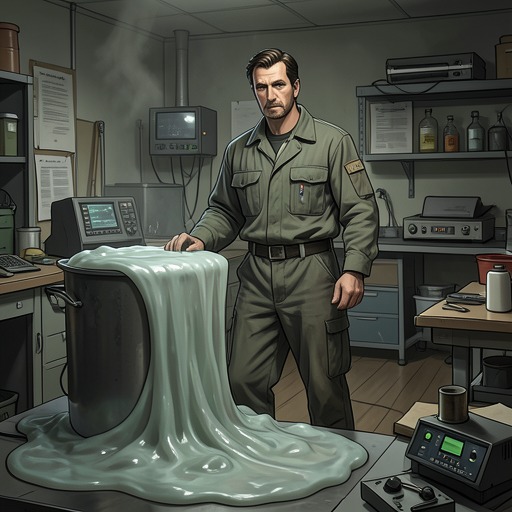
Industrial processing does more than package a stable resource. When full harvesting bins are sent to cracking and radiation plants, patented techniques cause the goo to multiply molecule by molecule, fragment, expand, and swell. The processed yield can reach about forty times its original weight before the material is rendered into food. This abundance helps keep a huge population alive, but it depends on a practice that treats a responsive, changing organism as raw material. Goo’s apparent usefulness therefore masks a question the industry has little reason to ask: what is it becoming while humans harvest and transform it?
Harvesting and Pareti
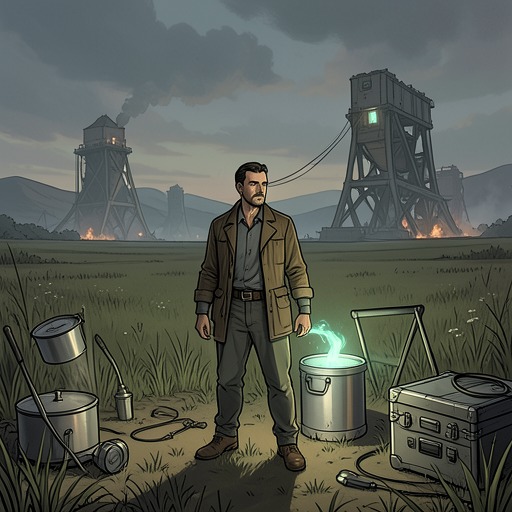
The industry builds harvesting factories called TexasTowers and trains workers to gather the organism. Harvesters receive the highest wages available in nontechnical work, officially classified as high-hazard pay. Pareti enters the occupation after deciding that his educational path is not suited to him; at first, he does not understand why his wages carry that designation. By the time the danger becomes clear, he has already spent years at sea.
His work is repetitive, skilled, and exhausting. Near the end of a shift, alone in a punt, Pareti spots a pale gray extension of goo rising above the ocean. He turns the boat, gauges the distance, and sweeps the organism up in a net fixed to a pole. The captured mass writhes against the mesh and climbs the aluminum handle. Pareti estimates it at five pounds, brings it aboard, and deposits it in the lazarette. The compartment closes around the material and seals it inside. A living organism has passed, through practiced movements and industrial equipment, into the harvest.
The routine has lasted three years. Pareti’s familiar curse has become a ritual that keeps him company during solitary shifts, though exhaustion has drained its usual force. The detail makes the work feel less like a dramatic confrontation with nature than a daily relation of labor, repetition, and capture. Pareti knows the organism by its visible movements and by the task it gives him; he has not understood that those repeated encounters may also be forming the organism’s understanding of him.
Recognition and Unresolved Future
The change in that relationship comes when the goo addresses Pareti through a telephone. It recalls his daily visits to the warm sea, the period when it was young and tried to hide, and his lifting it from the water and bringing it close. It describes trying to move up the pole toward his fingers and recalls the pet names he gave it. Its account turns the practical details of harvesting into a history of attention and attachment, though Pareti rejects its interpretation and insists that it has misunderstood him.
The goo also describes having encountered other men before Pareti, without having been able to become what it wanted. Its desire is not merely to resemble one of the rudimentary forms it produces: it is trying to discover a shape and a direction for itself. The principle it offers—that shape is bound up with a life’s course—makes its metamorphosis a matter of identity as well as biology. The organism that seemed to be a mute, unintelligent crop has retained the history of contact and learned to speak about it.
Pareti’s response is recognition. In the confusion of the encounter, he understands that people have underestimated the goo: it was young, but not unintelligent, and its powerful desire for form has been shaping its development. The story establishes that it is evolving, but does not reveal the outcome. Its final question to Pareti asks what he would like it to become, leaving its future open at the point where human beings must confront the possibility that the thing they harvest has its own trajectory.
Significance
Goo binds ecological catastrophe to human survival without resolving the contradiction between them. The contamination that follows war creates a mutation, and the mutation becomes food for a population left hungry by war’s devastation. Industrial ingenuity turns proliferation into abundance, but the very success of that conversion helps obscure goo’s capacities as a living subject. Its persistence in the sea and its repeated attempts to take form challenge the assumption that it exists only as a resource.
Pareti’s encounter makes this tension personal. The pole and net are tools of an established trade; in the goo’s recollection, they are also parts of a relationship that Pareti did not know he was making. The revelation does not cancel the material facts of harvesting or the world’s dependence on the food it supplies. Instead, it changes what those facts mean: the organism that sustains human life may be developing an identity through the very system that captures and processes it, and no one yet knows what that development will bring.